A reproducible MATLAB simulation study of optical pointing diagnosis under time-varying gain, uncertain measurements and finite actuator-model uncertainty.
Research status: partially complete against the IEEE Transactions goal. The implementation, mathematical audit, simulation study and manuscript are delivered. Absolute novelty, physical validation, faithful close published-system comparisons, source-rights confirmation and independent external review remain unresolved.
9,000 original benchmark trials reproduced; 29,250 new final simulation trials; all new scientific traces audited. Ten mathematical/model test categories, four analysis tests and nine legacy regression tests passed. The 141 protected original files were unchanged. Ninety-four evaluator premise labels were transparently corrected and replayed without changing performance outcomes.
The candidate contribution is a reference-relative conditional optical service certificate and an uncertainty-aware acquisition gate. It is not a globally established novelty or flight-safety claim. Mean affine-drift outage is 4.9730 s for the proposed UAD versus 4.2462 s for original DAP. At fivefold noise near the threshold, UAD has 0/50 false acquisitions versus DAP’s 2/50. Stronger comparators outperform UAD in other conditions; all adverse cases are retained.
From MATLAB at the project root:
start_research_v4
test_v4
% A new output folder; never overwrites supplied final data:
run_v4('replication_01')
For the supplied final data, extract the full project snapshot and V4 raw-data archive from the release into the same folder. The smaller code/report archive is an alternative source-focused download. The release includes SHA-256 manifests. MATLAB is required for V4; Simulink is required for legacy network regression. Python analysis uses the standard library. See the reproduction guide for plotting and paper compilation.
The inherited terminal/network model is reused and attributed in the provenance report. Human author approval, rights confirmation and independent scientific review are still required before paper submission. AI assistance is disclosed in the manuscript. No IEEE submission or hardware validation has been performed.
One integrated MATLAB/Simulink simulation: spacecraft motion changes optical pointing, optical power gates delayed state packets, received messages determine follower targets and local diagnosis can optionally adjust messaging/prediction during recovery.
The main experiment tracks a moving attitude command. Only SC1 receives that command. Followers maintain specified attitude offsets through a declared leader–follower chain (SC1 → SC2 → SC3 → SC4). They retain local stabilization during an outage, but cannot independently track the unknown moving command.
Tested on MATLAB R2026a Update 2. Simulink is required for the .slx model; the standalone simulator requires no specialized toolbox.
start_project for the moving-reference pointing-fault demonstration and live model.validate_tracking_model for core checks, information-access tests, and live parity through fault onset.run_tracking_pilot for the initial communication-dependence check.run_tracking_experiments for 108 main trials and, if the pilot supports it, 45 management-ablation trials.addpath src
c = isc_tracking_config('optical_event','pointing_actuator',11,'off');
r = isc_run(c);
disp(struct2table(r.trackingMetrics))
isc_tracking_plot(r,c,fullfile('results','my_tracking_case.png'))
build_model(c)
out = sim('IntegratedSatelliteControl');
To change an open model, assign c in its model workspace:
mw = get_param('IntegratedSatelliteControl','ModelWorkspace');
mw.assignin('c',c);
Keep src on the MATLAB path after reopening the model. Configuration helpers set mode booleans; call them to select a mode rather than editing only c.mode.
The expanded statistical evaluation is in the held-out report: 20 new run seeds, a locally frozen decision rule, new fault conditions and a second tree/network setting, and paired-seed confidence intervals. See the frozen protocol and claims and limits. Development results below remain unchanged, including adverse policy outcomes.
To reproduce it: run validate_holdout; create or verify the local lock with python tools/freeze_holdout.py --freeze; run run_holdout_experiments; run python tools/analyze_holdout.py; add explicit CSV units with python tools/annotate_ci_units.py; then plot_holdout_results. If sources differ from a supplied lock, do not silently overwrite it or describe changed code as the same frozen evaluation. The supplied lock records the sources used for the delivered results. Validation uses separate seeds 901/902.
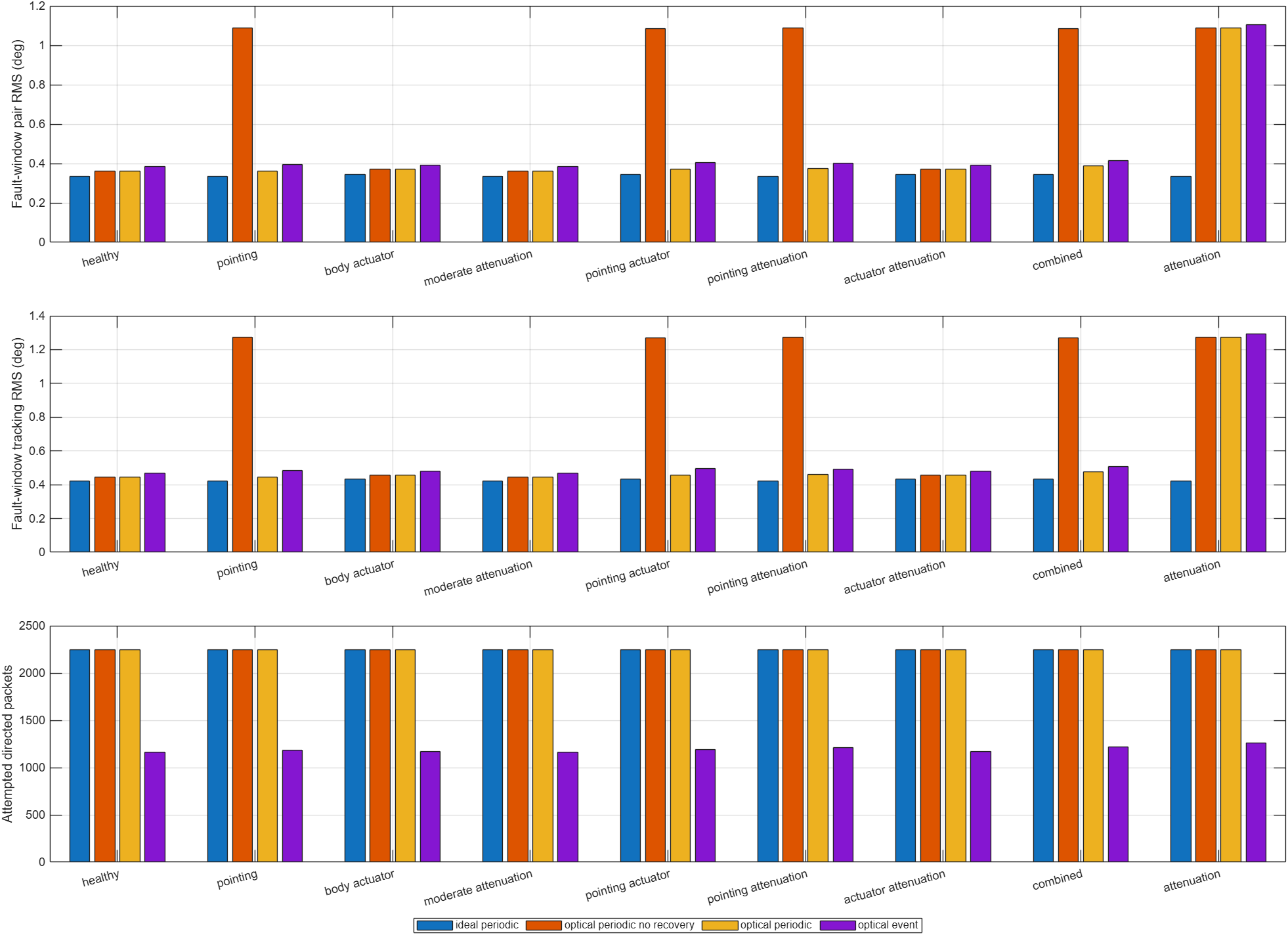
Start with the tracking report, comparison figure, and all trial values. Hypotheses and parameters were declared before inspecting rankings in the experiment plan.
| Configuration | State transport | Optical recovery | Scheduling |
|---|---|---|---|
ideal_periodic |
One-sample causal ideal delivery | Off | Periodic |
optical_periodic_no_recovery |
Power-gated, delayed, lossy | Off | Periodic |
optical_periodic |
Power-gated, delayed, lossy | On | Periodic |
optical_event |
Power-gated, delayed, lossy | On | Event-based |
Policies off, schedule, prediction, and both separately test diagnosis-informed per-link retries and bounded neighbor extrapolation. The default is off: a heuristic is not presumed to improve every metric. It uses only local pilot power, accepted optical estimates, and nominal correction limits, without injected fault values or true link availability.
Nine scenarios include the complete pointing/actuator/moderate-attenuation factorial and separate severe attenuation. Metrics include exact quaternion-geodesic pair disagreement, leader-relative error, tracking, torque effort, packet attempts/payload bytes, information age, physical availability, and verified recovery.
run_tracking_experiments exports paired-seed factorial contrasts through isc_tracking_interactions. After validation and experiments, the optional standard-library Python command python tools/report_tracking.py regenerates the Markdown report from those saved measurements. Python is not required to simulate or calculate the MATLAB tables.
isc_step is the physical/communication kernel. isc_tracking_target supplies command-dependent targets while preserving the local feedback form and observer. The live Simulink S-function executes this kernel. Its four spacecraft panels expose telemetry; they are not result playback or separate hardware processors. Telemetry has a documented one-sample output delay.
The earlier static-reference condition remains reproducible with start_static_project, run_experiments, and audit_recovery. Its 90-trial results and 30-trial recovery audit are background experiments in the same project. Do not substitute their percentages for moving-reference results.
See tracking equations and metrics, base physics, validation, and change history.